
Heroes of the Faith | Ken & Louise Board
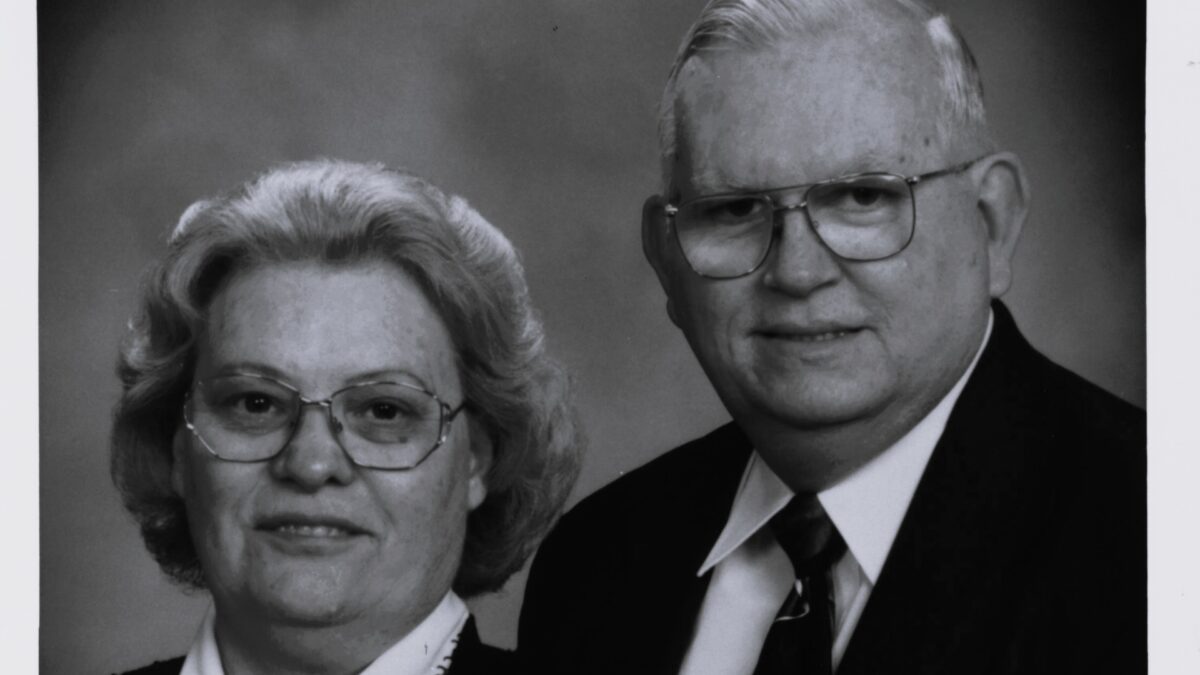
In the 1950’s, if your son suddenly no longer wanted to stay home and watch Walt Disney’s Disneyland (later called Wonderful World of Disney) on Sunday nights, you knew something was going on with him. Ken Board had recently attended Vacation Bible School at a new church mission near his home in Virginia and had trusted Christ as his Savior. When young Ken decided he would rather go to church on Sunday nights, his mom and stepdad wanted to know what had pulled him away from Disney! Before too long, they also became Christ followers. Ken grew in his faith; however, in his senior year of high school, he did not want to move to Jacksonville, Florida, with his family and was quite angry at the Lord. God was using this time in his life for His own glory and for Ken’s good.
Just after his family moved, Ken went to youth camp with their new church (now called University Baptist Church) and surrendered his life to the Lord. The only problem was that he was terrified of public speaking! Ken began praying about whether his ministry would be in the States or in a foreign country. There was continually a tremendous missions emphasis at the church and the pastor often preached about missions. One night, Ken was kneeling by his bed as usual and he prayed, “God, what is Your will for my life?” Nothing “weird” happened, but he suddenly knew in his heart that God wanted him to be a foreign missionary.
Ken also met his future wife, Louise, at that church and they went to Baptist Bible College together. They married after their second year. Upon graduation, they still did not know where God was calling them, so they returned home to serve on staff back in Jacksonville. A missionary couple, Stan and Helen Flynn, came home on furlough during that time and talked often with Ken and Louise about Japan. After praying about Japan for a year, the Boards knew God was leading them to Japan as well.
During deputation in the 1960’s, Ken would meet people, even in churches, who would still refer to the Japanese in vulgar terms. This broke his heart, but he was also greatly encouraged by the Baptist Bible Fellowship Missions Director, Fred Donnelson. Even though the Donnelsons had been imprisoned by the Japanese while serving as missionaries in China during WW2, they were a great encouragement to the Boards as they prepared to go to Japan.
It is reasonable to go to the mission field with expectations of fruitful ministries. But the Boards soon found that it can take 10-15 years to grow an autonomous, thriving church in Japan. Only 1% of Japanese claim to be Christians. Ken had only seen airline and travel agency commercials showing the “old Japan” and he expected to see women in kimonos and Samurai walking around when they arrived in 1968. He was amazed when they arrived and found modern cities, stores, and conveniences. If it wasn’t for the language barrier, they
might have forgotten they weren’t in America! Just as they found on deputation, they still met individuals who harbored bitter feelings from WW2, specifically on remembrance days for Hiroshima and Nagasaki, especially since their first church was on the same island as Nagasaki.
Some cultural adjustments were humorous: having to replace paper doors after accidentally knocking holes in them, taking their shoes off indoors, even for church services. Chuckling, Ken remembered they could take attendance by counting the shoes and dividing by two. They got used to not shaking hands or hugging, just bowing in greeting. Sitting on straw mats on their knees for long hours was difficult. There were times Ken literally had to crawl out of a room until his joints loosened enough to allow standing and walking again!
Japan was open to missionaries and the Boards distributed countless thousands of flyers over the years around neighborhoods and at train stations. They were also allowed to place flyers in mailboxes. Through the years, some of these efforts yielded great results, bringing curious visitors across their path. As the guests were moved by God’s Word and encouraged by the new relationships, lives were transformed by the Gospel and added to the three churches that were birthed and to other churches the Boards served. Sometimes thousands of flyers yielded little to no response, not even anger or disgust. “The Japanese don’t oppose you, they ignore you,” Ken recalled, and the Boards found that the apathetic, lost state of the Japanese brought them to tears at these times.
Learning Japanese was Ken’s most difficult endeavor. Learning languages was not new to him: he had studied Latin, German, and French in high school. Japanese was nothing like those, since its foundation is based on thousands of characters rather than a Roman alphabet and an entirely different sentence structure. Ken was comforted during this time by Mark 9:23, “ Jesus said unto him, If thou canst believe, all things are possible to him that believeth.” With no language schools nearby, they studied with an atheist tutor who became a friend: Mr. Kawano still has not trusted Christ, even after almost sixty years of friendship. Pray for his salvation! Eight years passed before Ken began to feel confident in the language, but even when one reads his prayer letters from decades later, he was still laughing at his hilarious mistakes in pronunciation nuances that would entirely change the meaning of words in his sermons and conversations at random times.
Ken used a translator for the second year in Japan, preparing sermons in English, then having them translated to Japanese, and doing his best to preach from that translation. They did have one unique blessing during the year he used a translator: Ken would give the translator his sermon a week in advance to be studied and prepared in Japanese. The Boards were still working with the Flynns during that time, and one week Ken got short notice that he would need to preach the mid-week service. The translator refused to help with a new sermon
without the usual advance preparation and insisted Ken re-preach what he had just preached on Sunday. A young lady who had heard the message on Sunday heard it again that Thursday night, and this time after hearing it, understanding dawned and she trusted Christ as her Savior.
How did Ken fight the terror of public speaking? Humor and illustrations! Ken found he had to learn the Japanese culture well enough to be able to make jokes and use play-on-words the people would find funny. In fact, the Japanese loved having humor interspersed in the sermons. Ken said using humor helped him alleviate his own nervousness, plus helped the people mentally adjust to his Japanese style of speaking. Ken’s ministry consisted largely of church planting and teaching, and in later years, he also did some guest speaking for groups and other churches. Whether the speaking was for luncheons in the community, lecturing at the Japanese Baptist Bible College hundreds of miles away, preaching at a church for American service members near a military base, or even at summer youth camps, the Lord helped Ken overcome the fear of public speaking.
Louise and their daughter Merri met a man while passing out flyers for an event showing Moody Science Films one Thursday, Friday, and Saturday. The man loved science and came each night, then attended the service on Sunday and got saved. He had never seen a baptism, so when Ken jokingly explained that he would hold him under water for 600 seconds, the man’s surprise was evident, but before Ken could let him know he was only joking, Ken was pulled away. During the entire service the man sweat profusely but still planned to go through with the baptism. He determined he would somehow just have to hold his breath for those ten agonizing minutes! Imagine his relief when Ken brought him up immediately out of that water! That man, still a friend to this day, later went through Bible college training and now pastors a church in Taiwan.
While keeping their marriage strong was important to the Boards, Ken humbly shared that he didn’t always keep his ministry and family in the proper order. His pattern of God, ministry, and then family, was very hard on Louise. But they sought godly counsel, and he learned to work hard at making his priorities God, family, and then ministry. He shares this testimony with young missionaries as much as possible.
The spiritual climate of Japan has gotten worse over the years. In the 1980’s, a Japanese doomsday cult called Aum Shinrikyo was founded, blending tenants of Buddhism, Hinduism and even Christianity, with its founder calling himself Christ and the “Lamb of God.” In 1995 this cult killed 13 and injured thousands in a sarin gas attack on a subway in Tokyo. Overnight, the children’s ministries in the Japanese churches were decimated, as parents associated the Christian phrases used by the cult with the teachings of the Bible. While this was devasting to the Boards’ ministries, the Lord brought a new kind of growth to the
churches, as they launched more family-oriented ministries so the parents could come and hear what the children were being taught.
Personal health was often a struggle for Ken. In 1999 he dealt with prostate cancer that spread to his bones. The chemo caused some depression which was a shock to his usually upbeat mind. Ken shared that Psalm 18:30 was a special encouragement in those dark days: “As for God, HIS way is perfect. . . ,” and also verse 32, “It is God that girdeth me with strength, and maketh MY way perfect.” Ken knew that even cancer could be made perfect in God’s way, and that God would use it in His plan for Ken’s life as well, just as He had turned the Tokyo subway bombings by the cult into broader family ministries within their churches. Those Psalms and others brought him through that dark season. In the following years Ken also dealt with increasing issues with diabetes and neuropathy in his feet.
The Boards’ children, Timothy, Rebecca, Merri, and Tabitha, all served alongside their parents in the church, especially through their teenage years. The older three had adapted to the Japanese culture quickly after learning the language, and Tabitha, born 14 years after the other three, grew up completely in the Japanese culture. Timothy still lives there to this day.
After over 45 years of marriage and 41 years of missionary work, Louise passed away in her sleep of a cerebral hemorrhage in Japan in November 2007. The next several months were very difficult, and during that time Ken said he prayed two prayers, “Help me, Lord,” and “Take me Home too!” But God’s calling kept him in Japan for 13 more years.
Ken loves the Japanese people and is still very concerned for the spiritual future of Japan. He had hoped the 2011 earthquake and tsunami in Japan would cause more of a revival and spiritual awakening than it did. Ken reflected that ministering alongside so many wonderful Japanese Christians, as well as partnering with faithful, supporting churches and individuals in the States for over fifty years, was a delight. Ken stressed he wants believers considering ministry work to remember one thing: “Make absolutely certain, 100%, that it is God’s will. If you don’t, you won’t last, especially in Japan. You have to have assurance of that, no matter if it is in America or anywhere.” The churches and the continuing generations of believers are the legacy Ken left behind when he finally retired to the States due to his progressing health issues.
Ken is now living with his daughter, Rebecca, and her husband, Matt Moore (son of missionaries Dan and Sharon Moore) in Florida, although it might not be valid to consider him fully retired. Besides doing pulpit supply as needed, Ken is a deacon at his local church, which, he likes to say, technically makes him a “Deacon Board.” He preaches weekly at a retirement home, makes visits for the church, and on Wednesday nights, he teaches a class
of kindergarteners! He doesn’t teach that class alone, but with his fiancé, Shirley! Lord willing, this September, they both will participate in the 40th anniversary of one of the churches in Japan. Ken has also published two books of short stories with biblical applications from daily life in Japan that could serve as an enjoyable addition to any personal devotional plan, and even provide fresh content for bulletins, newsletters, and ministry websites. The Japanese translation of the first book is, “Amusing Grace.”
As Ken learned over the years, God’s way is perfect AND He can also make our way perfect, even via His “amusing grace” in our lives.
-written by Janette Lange, BBFI Contributions Manager